Research Interests
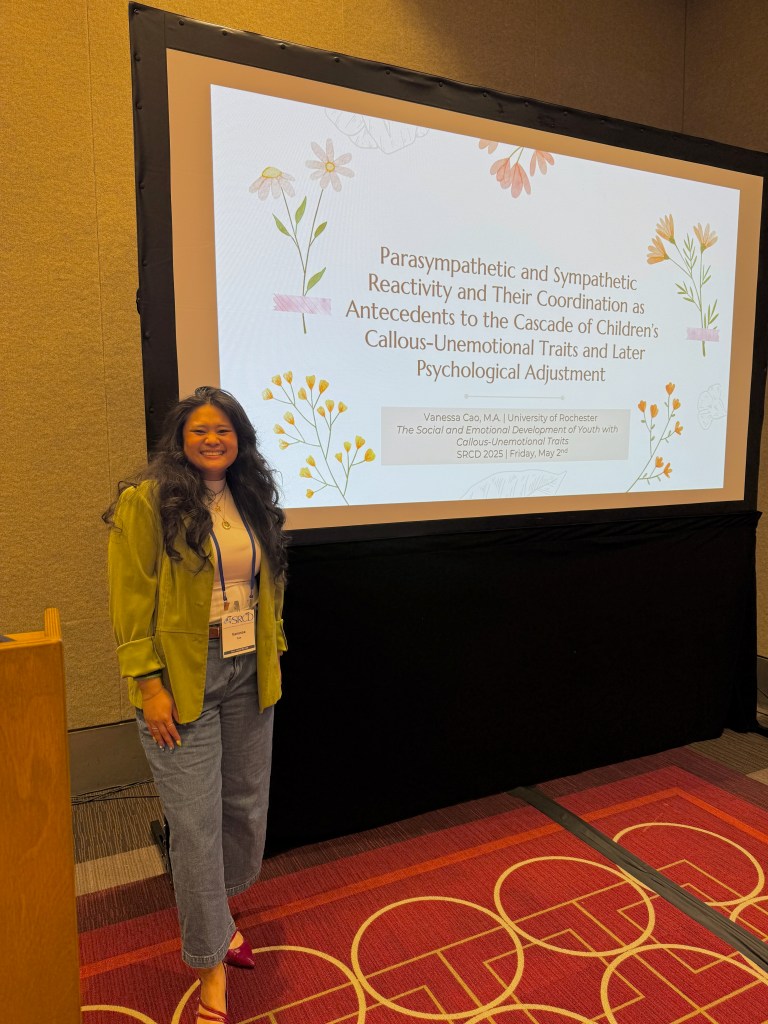
Across my research, I have developed a programmatic focus on understanding how family adversity, instability, and stress-related trauma shape children’s socioemotional development across early childhood, with particular attention to populations from diverse economic and racial and ethnic backgrounds. My work centers on family systems processes spanning interparental, parent–child, and peer contexts, and understanding the development and consequences of callous–unemotional (CU) traits. Guided by developmental systems and resilience frameworks, I adopt a strengths-based perspective that highlights plasticity, heterogeneity, and opportunities for intervention.
My work centers on four interconnected areas:
(1) identifying processes that give rise to CU traits and related externalizing behaviors, with a focus on mechanisms underlying their emergence and consolidation in early childhood
(2) clarifying when and how family dynamics, including interparental conflict and parenting processes, function as sources of risk or resilience across development
(3) uncovering patterns of sensitivity and adaptation that reveal how adversity reorganizes children’s developmental systems, with attention to individual differences in reactivity and regulation
(4) advancing translational and applied research through program evaluation, intervention research, and sustainability-focused work that strengthens community-based programs
Across these areas, I use multi-method, longitudinal approaches to capture children’s development across contexts and levels of analysis, integrating behavioral, physiological, and contextual data. This work is embedded within a broader commitment to bridging developmental science with practice, with the goal of generating evidence that informs prevention efforts, strengthens intervention programming, and supports systems that serve children and families.
Current Research
University of Rochester | Mount Hope Family Center (MHFC) | Noll Lab
PI: Dr. Jennie Noll
In my current role at Mount Hope Family Center, I lead translational and evaluation-focused work aimed at strengthening community-based programming for children and families. Working with Dr. Jennie Noll, I am advancing a comprehensive evaluation of PATHS, a long-standing after-school and summer program designed to support socioemotional development, behavioral regulation, and adaptive coping among children exposed to adversity. This work integrates program records with school district administrative data to examine impacts on children’s educational and socioemotional outcomes, while also strengthening the program’s evidence base through improved outcome measurement and analytic strategy. Across this work, I contribute to evaluation design, data infrastructure development, and advanced quantitative analysis, as well as coordination with institutional and community partners. This translational work is embedded within a broader goal of improving program sustainability, enhancing data-informed decision making, and supporting systems that serve children with elevated behavioral and emotional needs.
Children’s Institute | https://www.childrensinstitute.net/
Since August 2025, I have served as a Research Associate at Children’s Institute, where I lead and support multiple applied research and evaluation projects focused on early childhood social emotional development and school based prevention. I serve as the Primary Research Coordinator for the Primary Project Pre-K Study, a multi-site randomized trial and optimization study of play based, school embedded interventions for young children exhibiting early behavioral and emotional risk, while also contributing to additional intervention and follow up studies within the institute’s early childhood portfolio. Across projects, I oversee research operations spanning multiple school districts, including site coordination, study timelines, data sharing agreements, staff supervision, and data management, and contribute to analytic planning, fidelity monitoring, and the development of manuscripts, protocols, and funder facing materials.
Past Research
University of Rochester | The Rochester Center for Research on Children and Families
PIs: Dr. Patrick Davies and Dr. Melissa Sturge-Apple
In Fall 2020, I joined the Rochester Center for Research on Children and Families (RCRCF) as a Ph.D. student in Developmental Psychology with a focus in Quantitative Methods, under the mentorship of Dr. Patrick Davies. The RCRCF investigates child development through the lens of family relationships and processes (e.g., interparental conflict, parenting, family systems). I initially became involved in Project THRIVE (Teamwork and Happiness in Relationships and its Intergenerational Value and Effectiveness) as a graduate research assistant. For several years, I have served as the primary behavioral coding manager, overseeing over a dozen coding teams and implementing more than ten coding manuals across three different waves of data (e.g., observational ratings of parent–child interactions, interparental conflict, and child behavior).
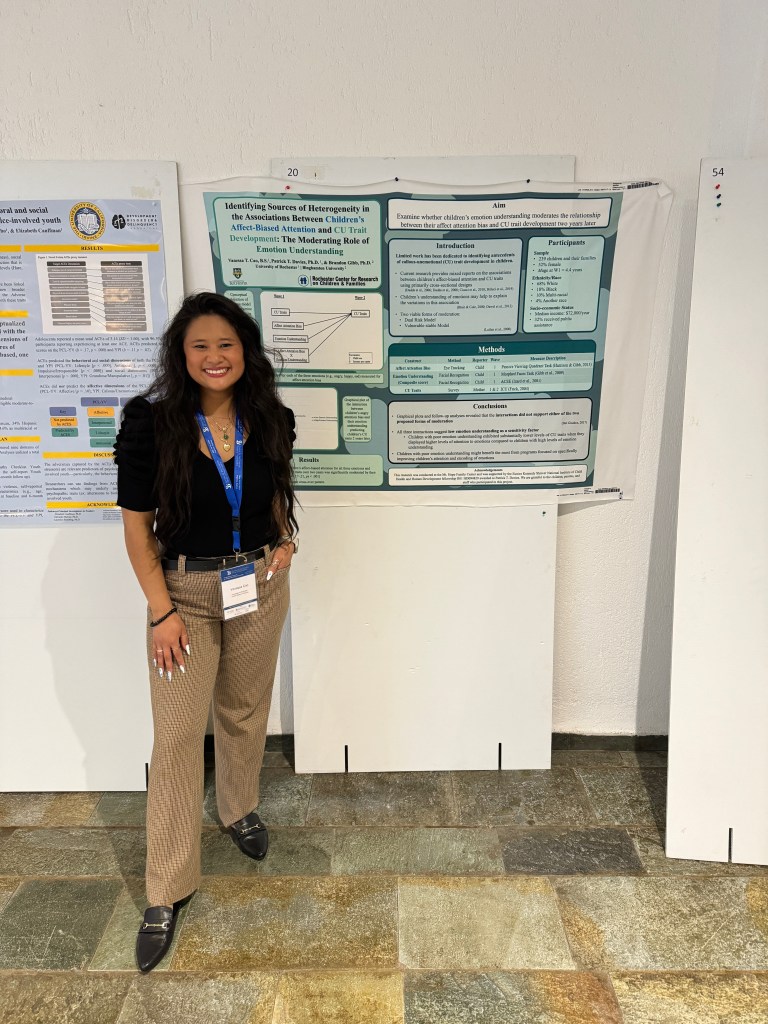
During graduate school, I was secured an NIMH NRSA F31 fellowship, which supported my independent research examining developmental risk mechanisms associated with callous-unemotional (CU) traits and externalizing problems in early childhood (e.g., physiological regulation, attentional biases, family adversity). Through this work, built a research program aimed at understanding the emergence of aggression and CU traits within the broader familial context, while continuing to contribute to the lab’s longitudinal projects on children’s socio-emotional adjustment.
The Children’s Agenda | https://thechildrensagenda.org/
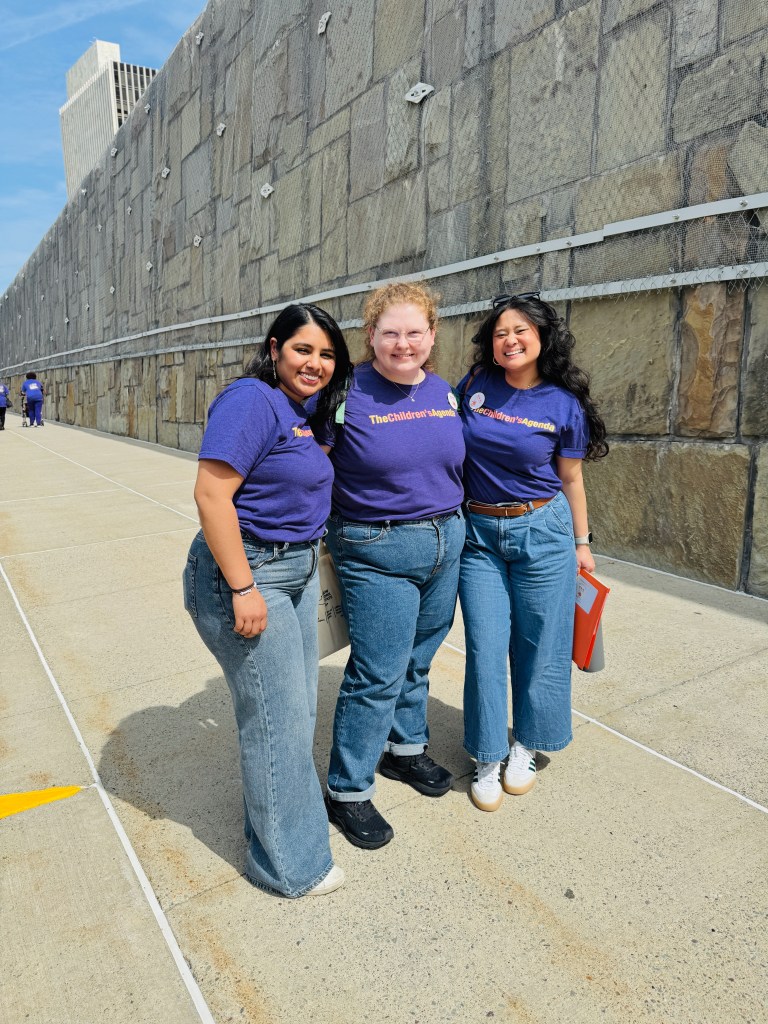
From May 2025 to August 2025, I served as a Research and Policy Intern at The Children’s Agenda, where I conducted applied quantitative analyses to inform child and family policy at the local and state level. My work focused on early care and education systems, including analyses of child care capacity, affordability, and access using large administrative and population based datasets. I translated these findings into policy briefs, fact sheets, and stakeholder facing materials, strengthening the connection between developmental research, public policy, and data driven advocacy.
Penn State Health | The Attention and Behavior Clinic (ABC) Research Group
PIs: Dr. Daniel Waschbusch, Dr. Dara Babinski, Dr. James Waxmonsky
In August 2018, I was selected as a Research Coordinator for the ABC Research Group at Penn State’s College of Medicine and have since gained a wide range of research, clinical, and administrative skills. The lab focuses on understanding the antecedents and mechanisms underlying externalizing disorders in children (e.g., ADHD, ODD, CD), with an emphasis on identifying both negative and positive influences on child behavior. A niche area of interest in the lab is the study of callous-unemotional (CU) traits and how children regulate emotions and respond to reward and punishment. My responsibilities span multiple domains, including administrative tasks (e.g., budgeting, IRB submissions, maintaining the lab website, scheduling participants, recruitment), research implementation (e.g., conducting intake sessions, collecting EEG and fMRI data), study coordination (e.g., managing treatment, non-treatment, and clinical trial protocols), and clinical work (e.g., staffing the annual Summer Treatment Program). I have also gained substantial experience in data management and analysis (e.g., REDCap, Qualtrics, SPSS, R) and contribute regularly to dissemination efforts (e.g., interpreting results, writing manuscripts, abstracts, and posters). I am deeply grateful for this team and the comprehensive experiences I’ve gained, which have made me a more efficient, well-rounded researcher and affirmed my interest in this work.
Penn Medicine | Lancaster General Hospital | Department of Trauma Surgery
PI: Dr. Eric Bradburn
After graduating from Penn State in May 2018, I was selected as a Summer Research Intern in the Department of Trauma Surgery at Lancaster General Hospital. During this internship, I primarily observed patients in the Trauma-Neuro Unit, conducted literature reviews, assisted in writing manuscripts, abstracts, and posters, and coded epidemiological data for ongoing clinical research projects.
The Pennsylvania State University | The Relationships and Stress Lab
PI: Dr. Amy Marshall
In 2017, I joined Dr. Amy Marshall’s Relationships and Stress Research Lab as a Research Assistant, motivated by a desire to shift my research focus from plant systems to human behavior. During my first year in the lab, I worked on a project examining heterosexual dyadic interactions, coding behaviors across three domains: physical aggression, social dominance, and rejection-abandonment. In my second year, I was selected to serve as Lab Manager, taking on a leadership role in maintaining lab organization and operations. I also contributed to a new project investigating co-regulation within couples through analysis of vocal frequency dynamics. After graduating from Penn State, I continued working with Dr. Marshall remotely, primarily conducting literature reviews and behavioral data coding.
The Pennsylvania State University | Freshman Research Initiative (FRI)
PIs: Dr. Kim Nelson and Dr. Glenna Malcolm
At the start of my undergraduate career in Fall 2015, I participated in the pilot cohort of Penn State’s Freshman Research Initiative, an immersive program designed to engage first-year students in hands-on, wet lab research. During my first semester, I conducted an independent project investigating the effectiveness of Triclosan-based soap products in inhibiting bacterial growth. In my second semester, I joined Dr. Charles Anderson in the Plant Cell Wall Dynamics Lab, where I contributed to efforts to identify transgenic wheat strains with improved tolerance to environmental stressors (e.g., extreme temperatures and highly acidic or basic conditions)
The Pennsylvania State University | Valentine Turfgrass Research Center
PI: Dr. Wakkar Uddin
My interest in research began during middle and high school through early exposure to Penn State’s Turfgrass Center, where I had the opportunity to conduct independent plant pathology studies for various science fairs. As a laboratory assistant, I contributed to ongoing projects by entering data, collecting samples, and preparing them for analysis.

